Who Really Decides How Fort Worth Grows: Inside the Rezoning Machine
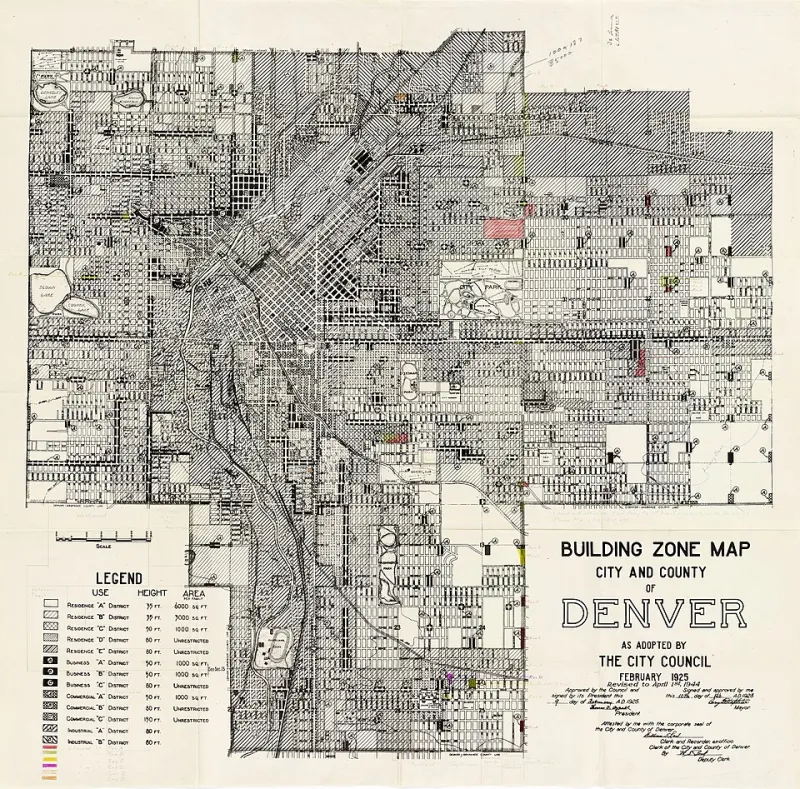
Photo: Denver (Colo.). City Council, Public domain, via Wikimedia Commons
Fort Worth's rezoning petition process is supposed to be guided by the city's comprehensive plan—a document years in the making that reflects community input and long-range vision. But a closer look at approval rates, staff recommendations, and the distance between policy language and actual outcomes reveals a system where political influence often outweighs planning principles.
For most residents, rezoning feels like something that happens to a neighborhood rather than something they participate in shaping. A sign goes up on a vacant lot. A notice arrives in the mail. A hearing date appears in small print on a city website. By the time most people understand what is being proposed, the machinery of approval is already well in motion.
How a Rezoning Petition Actually Moves
The formal process begins when a property owner or developer files a rezoning application with the city's Development Services Department. Staff planners then review the application against the city's adopted Comprehensive Plan, neighborhood plans, and applicable zoning ordinances. That review culminates in a written staff recommendation—either for approval, approval with conditions, or denial.
The application then proceeds to the Zoning Commission, a body of appointed residents who hold public hearings and issue their own recommendation. From there, it advances to City Council, which casts the binding vote.
On paper, this is an orderly, policy-driven sequence. In practice, the gaps between each stage tell a more complicated story.
The Approval Rate Problem
A review of Fort Worth zoning records from recent years reveals that the vast majority of rezoning petitions that reach City Council are ultimately approved—even in cases where staff recommended denial. Estimates from planning observers and case-file reviews suggest that council approval rates for contested rezonings hover well above 70 percent, and in some periods approach 80 to 85 percent.
That number would be unremarkable if it simply reflected well-prepared applications that aligned with city policy. But a meaningful subset of those approvals come after staff planners—the professionals whose job it is to evaluate consistency with adopted plans—have explicitly recommended against them.
When elected officials routinely override their own planning staff, one of two things is true: either the staff recommendations are systematically miscalibrated, or the decision-making process is being driven by factors that the public record does not fully capture.
Planning professionals and civic advocates who have tracked Fort Worth's land use process for years tend toward the latter explanation.
What the Comprehensive Plan Actually Says
Fort Worth's Comprehensive Plan is a lengthy, aspirational document that establishes a framework for where different types of development should occur, how density should be distributed, and what kinds of transitions between land uses are appropriate. It is not a legally binding zoning code, but it is supposed to function as the foundational reference point for rezoning decisions.
The plan calls for directing higher-intensity development toward designated growth corridors and activity centers, protecting established residential neighborhoods from incompatible uses, and ensuring that infrastructure capacity keeps pace with new development approvals.
Review those principles against a sample of recent rezoning approvals in Fort Worth, and the alignment is inconsistent at best. Applications for commercial and high-density residential development in areas the plan designates for low-intensity use have been approved with regularity. Infrastructure concerns flagged in staff reports have been noted and then set aside. Neighborhood plan designations—documents that themselves took years to produce with resident input—have been treated as advisory rather than authoritative.
The Timeline Gap and What It Reveals
Another dimension of the rezoning process that deserves scrutiny is timing. From application submission to final council vote, a rezoning petition can take anywhere from three months to well over a year, depending on the complexity of the request and the degree of community opposition.
What is notable is not the length of the timeline but what happens during it. Applications that face organized neighborhood opposition tend to be continued—postponed to future hearing dates—multiple times before reaching a final vote. This continuance pattern can work in two very different directions.
In some cases, continuances give residents more time to organize, document their concerns, and build coalitions. In other cases, they serve as an attrition mechanism: hearings are rescheduled to dates when fewer residents can attend, opposition fatigue sets in, and the eventual vote occurs before a diminished audience.
Planning advocates have noted that well-resourced applicants—those with experienced land use attorneys and established relationships within city government—are generally better positioned to navigate continuances strategically. Neighborhood groups operating on volunteer time and limited budgets are not.
Staff Recommendations: Rubber Stamp or Real Guidance?
The role of staff recommendations in the rezoning process merits particular attention. When staff recommends approval, council almost always concurs. When staff recommends denial, the outcome is far less predictable.
This asymmetry matters because it suggests that staff recommendations function primarily as validation rather than as independent professional judgment. A favorable staff report accelerates an application toward approval. An unfavorable one creates friction but rarely proves decisive when a determined applicant has council relationships to draw upon.
Several current and former city planning professionals, speaking in general terms, have described an environment in which the direction of politically significant applications is sometimes signaled before the formal review process concludes. Staff recommendations, in those cases, are written to reflect a conclusion that has already been reached through informal channels.
This is not a dynamic unique to Fort Worth. It is a structural vulnerability in any planning system where elected officials hold final approval authority and maintain ongoing relationships with the development industry. But acknowledging that it is common does not make it acceptable.
The Political Geometry of Rezoning
Council members in Fort Worth represent single-member districts, which means that most rezoning decisions are effectively made by the council member in whose district the property sits. The convention of council deference—the informal norm under which colleagues defer to the district representative on local land use matters—concentrates enormous power in individual offices.
This structure creates a direct line between developer relationships with specific council members and rezoning outcomes. Campaign finance records, which FW Action has examined in previous reporting, show that real estate and development interests are among the most consistent contributors to Fort Worth council campaigns. The connection between donor relationships and land use outcomes is not a matter of speculation; it is a pattern visible in the public record.
What Residents Can Do
Understanding the rezoning process is the first step toward intervening in it effectively. Residents who want to influence land use decisions in their neighborhoods should begin tracking applications early—the city's development portal lists pending petitions, and signing up for notifications in specific zip codes is possible through the Development Services Department.
Appearing at both the Zoning Commission hearing and the City Council hearing matters. Written comments submitted before hearings become part of the public record and can be referenced in legal challenges if an approval is later contested. Coordinating with neighboring residents, documenting infrastructure and plan-consistency concerns in writing, and engaging directly with the relevant council member's office—before a vote, not after—are all tactics that experienced advocates have found effective.
The rezoning process is not designed to be easy for ordinary residents to navigate. But it is, at least formally, a public process. The gap between what the rules say and what actually happens is not fixed. It narrows when residents show up informed, organized, and persistent.
Fort Worth's land use map is being redrawn continuously, one petition at a time. The question is not whether those decisions will be made—it is whether the public will be present when they are.